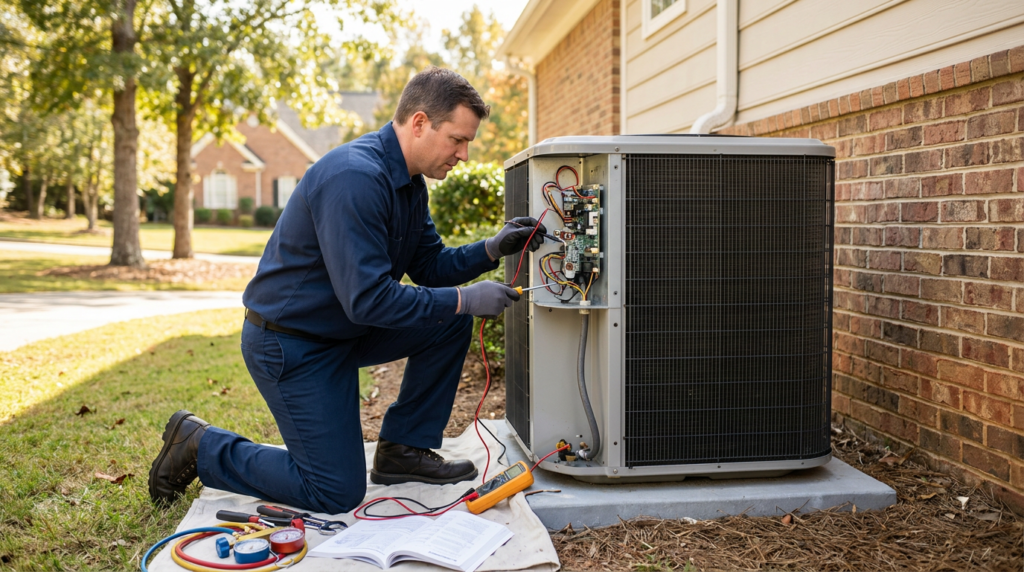
Quick answer: You usually need heating repair if the system still heats but shows specific issues like short cycling, odd smells, weak airflow, or noisy operation. Replacement makes more sense when the unit is consistently failing, parts are no longer available, the heat exchanger is damaged, or repairs keep stacking up. A technician can confirm with combustion checks, temperature rise, and a full safety inspection.
Fast Signs It’s Likely a Repair
If your heat turns on but feels “off,” a targeted repair is often the right first step. Common clues include a furnace that starts and stops every few minutes (short cycling), a blower that runs but delivers lukewarm air, or rooms that never quite catch up to the thermostat setting. These problems are frequently tied to airflow restrictions (dirty filter, blocked return), a failing igniter, a weak flame sensor, or a thermostat issue rather than the entire system being worn out.
Safety and comfort symptoms matter too. A brief dusty smell at first startup can be normal after months of inactivity, but persistent burning odors, repeated pilot/ignition failures, or rattling and squealing noises deserve prompt attention. If you’re scheduling heating repair Bishop GA, ask for a full heat-cycle check so the tech verifies ignition, flame stability, blower operation, and that the system shuts down correctly.
One simple homeowner check: confirm the filter is clean and the supply/return vents are open. If the filter loads up quickly, that can point to duct leakage, an oversized filter slot, or indoor air quality issues that are stressing the system.
Bishop, GA Heating Realities: System Types, Weather, and Safety Basics
In the Bishop area, many homes heat with either an electric heat pump (often paired with auxiliary electric heat strips) or a gas furnace (natural gas or propane, depending on the neighborhood). Heat pumps are common in Northeast Georgia because winters are usually mild with occasional cold snaps. That mix can create a pattern where a heat pump runs efficiently most days, then relies more on auxiliary heat during colder mornings or when the thermostat is raised several degrees at once.
Local weather can also make short cycling show up in specific ways. On milder days, an oversized furnace or heat pump may satisfy the thermostat too quickly and shut off before it circulates heat evenly, which can feel like uneven temps or frequent starts. During colder snaps, a heat pump that’s struggling may run long cycles and kick on auxiliary heat more often than you expect. That can be normal in cold weather, but it can also signal airflow problems, incorrect thermostat settings, or a system that isn’t performing as designed.
For safety expectations, treat combustion appliances (gas furnaces, propane furnaces, and any vented heaters) as “test and verify” equipment. Keep working carbon monoxide (CO) detectors installed per the manufacturer’s instructions and any applicable local requirements, and replace batteries on schedule. A technician should also confirm proper venting and draft, because those are the basics that keep flue gases moving outdoors.
Red Flags That Point Toward Replacement
Replacement becomes more attractive when reliability and safety are in question. If your furnace needs repairs repeatedly in the same season, or the repair list keeps growing from one visit to the next, you may be throwing good money after bad. Another big driver is parts availability; for older equipment, certain control boards, inducer motors, or proprietary igniters can be hard to source or expensive compared to the value of the unit.
Pay close attention to signs of a compromised heat exchanger, which is a serious safety concern. Cracks or failure can allow flue gases to mix with indoor air. You can’t diagnose that visually from the outside, but warning signs can include soot-like staining near the furnace, a burner flame that looks unstable, or household members feeling unwell. Health symptoms (like headaches or nausea) are not diagnostic on their own, so treat them as a reason to take precautions and get the system checked promptly, not as proof of CO.
If comfort is consistently uneven, replacement may also be a chance to correct underlying sizing or duct problems. A new furnace that’s still oversized, undersized, or connected to leaky ducts won’t feel like an upgrade, so the evaluation should include airflow and duct static pressure checks.
A Practical Repair-or-Replace Checklist and What to Ask
Use this quick checklist to make the decision more concrete:
Repair tends to make sense when: the issue is isolated to one part (igniter, capacitor, sensor, thermostat), the system is otherwise safe, and performance returns to normal after the fix.
Replacement tends to make sense when: breakdowns are frequent, the same failure repeats, major components are stacking up, parts are hard to get, a safety-related failure is confirmed (like a failed heat exchanger), or comfort problems trace back to sizing/duct issues that a new matched system can address.
Cost comparisons help, but avoid rigid rules. Many homeowners use a rough threshold like “if the repair is a large fraction of the cost of replacement, consider replacing,” while also weighing safety findings and parts availability. Age can be a tie-breaker: furnaces often last around 15–20 years, but that varies widely with installation quality, usage, maintenance, and local conditions, so age alone shouldn’t decide it.
Questions to ask your technician:
• What failed, and what test confirmed it?
• Is the system operating safely (combustion/venting for gas, electrical checks for heat pumps)?
• What’s the expected reliability after this repair, and what are the next likely failure points?
• Are replacement parts readily available for this model?
• Did you check temperature rise, static pressure/airflow, and duct leakage indicators?
• For heat pumps: is auxiliary heat running when it should, and is defrost working correctly?
Immediate safety steps: If your CO alarm sounds, or you notice a strong combustion/exhaust odor, shut off the heating system if you can do so safely, open windows/doors to ventilate, leave the home, and call emergency services (and/or your gas utility) from outside. Don’t re-enter until you’re told it’s safe. For help sorting out repair vs. replacement after a safe shutdown, Billy Butler HVAC can inspect your system, explain the findings in plain language, and recommend the most practical next step.